Exam Tips
How to improve faster using an exam log
View my exam log and learn how you can make your own and how you can improve faster !
How to Improve Faster Using an Exam Log
By Dr Devang Krishna
One of the questions I get asked most often is:
"How do top students improve so quickly?"
Most people assume it's because they're naturally smarter.
After teaching hundreds of students preparing for Selective Entry, JMSS and scholarship exams, I can confidently say that's usually not the case.
The students who improve the fastest simply learn from their mistakes better.
And one of the easiest ways to do that is by keeping an Exam Log.
What is an Exam Log?
An Exam Log is exactly what it sounds like—a place where you record and analyse the mistakes you make after every practice exam.
Notice I said analyse, not just record.
Most students finish a mock exam, look at their score, check the answers, and move on.
The problem is that your score doesn't tell you why you lost marks.
Your mistakes do.
Don't Record the Question—Record the Reason
When you get a question wrong, avoid writing something like:
Question 17 - Incorrect
Instead, identify the reason behind the mistake.
For example:
Vocabulary I didn't know
Misread the question
Careless calculation
Ran out of time
Didn't recognise the pattern
Weak algebra skills
Eliminated the correct answer
Changed my answer unnecessarily
The goal is to identify patterns, because patterns reveal your weaknesses.
After 3–4 Practice Exams, You'll Notice Something Interesting
Once you've completed a few exams, your Exam Log starts telling a story.
Maybe you notice:
Most of your Reading Comprehension mistakes come from inference questions.
You consistently lose marks from careless arithmetic in Maths.
Analogies are costing you several Verbal Reasoning questions every exam.
You panic whenever a Numerical Reasoning question looks unfamiliar.
These are no longer random mistakes.
They're recurring habits.
And recurring habits are exactly what you should be working on.
This Is Where Improvement Happens
Many students think improvement comes from doing more and more questions.
Sometimes it does.
But often, improvement comes from understanding why you're getting questions wrong in the first place.
One carefully reviewed practice exam can teach you more than three rushed ones.
That's why I encourage my students to spend almost as much time reviewing an exam as they spent sitting it.
The learning doesn't stop when the timer ends.
In many ways, that's when it actually begins.
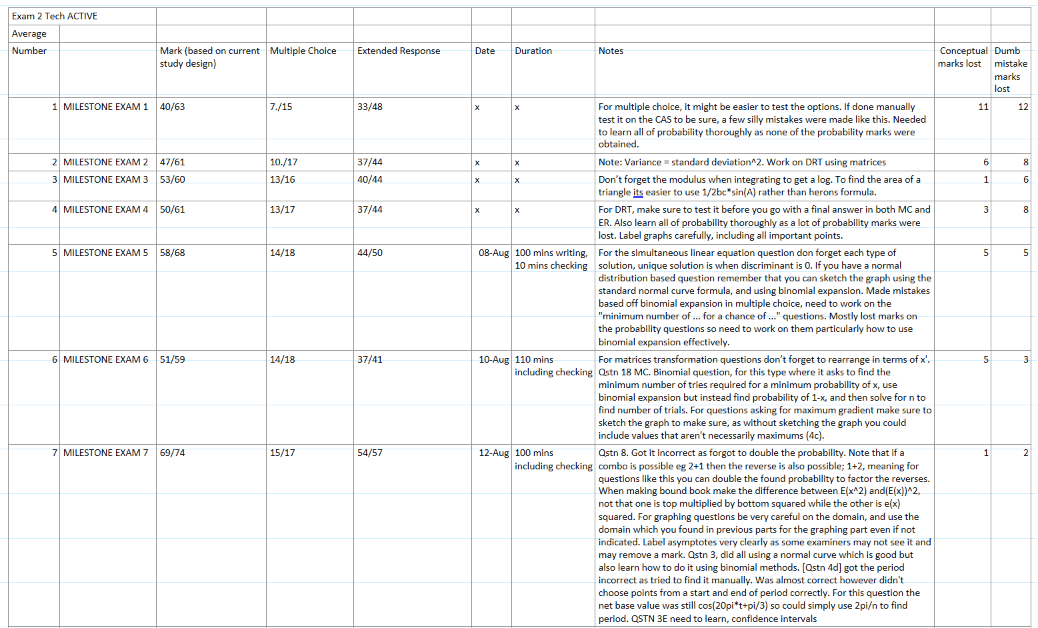
My log
To help students review their exams more effectively, I've included my own template that I used to use, which is the same example I show my own students.
Remember:
Don't just practise.
Practise, reflect, improve and repeat.
That's how top students improve faster than everyone else.